What “Hub-and-Spoke” Means (and How It Creates More Flight Delays)

Updated: Aug 29
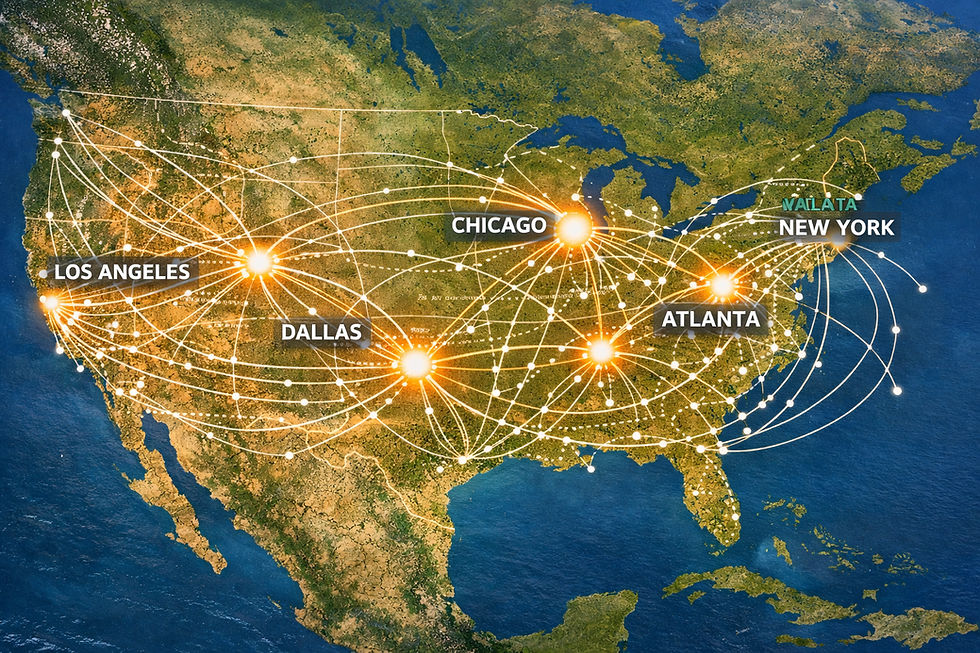
Most flyers have no idea of the many reasons for flight delays. When you do better understand, it's hard to believe we have as many on-time flights as we do! But a bit of knowledge about how flight itineraries are constructed can help you understand the system better--- including how to plan more effectively for greater success instead of just hoping to get lucky.
If you’ve ever taken a flight with a connection, you’ve already experienced the hub-and-spoke system—even if you didn’t know what it was called. And it affects all of us.
Here’s the simple version:
Hubs are major airports where airlines route a lot of their flights for connections.
Spokes are the routes that connect smaller cities to that hub.
Instead of flying everywhere nonstop, airlines funnel passengers through these hubs to connect them to their final destination.
Example: Flying from Pittsburgh to Athens might look like: Pittsburgh → Philadelphia → Athens
That middle stop (Philadelphia) is the hub—and it’s doing a lot more work behind the scenes than most people realize.

Why Airlines Use This Hub-and-Spoke System
This setup isn’t random—it’s about efficiency.
It lets airlines serve more cities
It keeps planes fuller (which keeps costs down)
It gives travelers more options
Without hubs, you’d have far fewer flight choices—especially from smaller airports.

The Down-Side of Hub-and-Spoke
But here’s the trade-off:
Everything becomes connected.
And when everything is connected, problems don’t stay small.
Flights Aren’t Independent (This Is the Key)
A lot of people assume their flight is just… their flight.
It’s not.
That plane you’re boarding?
It likely flew in from another city earlier that day
It’s scheduled to go somewhere else after you land
The crew?
They’ve probably already worked one or two flights
They’re scheduled for more
Passengers?
Many are connecting—just like you
So when one thing gets delayed, it starts a chain reaction.

How One Problem Turns Into a Nationwide Issue
Let’s walk through how this actually plays out.
1. Something Goes Wrong at a Hub
It could be:
Weather
A mechanical issue
Air traffic control delays
Staffing shortages
Or an unexpected incident on the ground
Flights into that airport slow down or stop. Departures get delayed or canceled.
That’s where it starts.
2. Planes and Crews Get Out of Position
Here’s where things snowball.
Planes are scheduled like a domino line:
If one doesn’t make it to its next city, every flight after that is affected
Crews are even more sensitive:
They have strict legal limits on how long they can work
If they “time out,” they can’t continue—even if the plane is ready
Now you don’t just have one delay—you have multiple flights impacted.
"I was flying home from Seattle to Philadelphia via Denver. Our evening flight out of Denver had an announcment of an expected delay of about an hour for a minor mechanical issue. An hour later, we were advised that the delay would take longer than initially expected and it would be at least another hour. And then a third announcment--- the original flight crew had timed out, and we had to wait for new pilots and flight attendants to be called in and arrive at the plane. We didn’t leave Denver until around 1 a.m." -Connie
3. Connections Fall Apart
This is where travelers really feel it.
If you’re connecting through that hub:
You miss your next flight
The next available seat might be hours—or even a day—later
Hotels fill up quickly
Rebooking lines get long
And remember—you’re not the only one. Hundreds of people are in the same situation.
4. The Domino Effect Spreads Everywhere
Now the disruption moves outward:
A delayed plane in Chicago affects a flight in Denver
That Denver delay impacts a flight to Los Angeles
That Los Angeles flight delays an international departure
Suddenly, a problem in one airport is affecting travelers across the country—and even globally.
This Can Last Longer Than You Think
Here’s something most people underestimate:
Airlines don’t just “fix it” in a few hours.
Planes are in the wrong places
Crews need rest or replacements
Flights are already full
It can take a full day or even several days for everything to get back on track.
How This Can Affect You
Even if your departure airport looks completely fine, you can still be impacted.
Your plane might be coming from a delayed city
Your crew might be stuck somewhere else
Your connection could disappear
Your flight could be canceled with little warning
This is why people say:“But the weather is fine here—why is my flight delayed?”
Because your flight is part of a much bigger system.

It’s Not Just “Winter Weather”
A lot of people assume major delays are mostly caused by snowstorms.
That’s not reality.
A few years ago, I started keeping a list of real-life situations that caused travelers to miss their departures. I'm now at 25 events that act as examples of similar types of delays. These include:
Aircraft mechanical issues
Crew shortages or timeouts
Air traffic control delays
Ground equipment failures
Medical emergencies on board
Security incidents
Airport shutdowns
And yes—weather, but not just winter weather
The takeaway? Disruptions can happen at any time of year, for many different reasons.
Why This Matters for Your Plans
This isn’t just about being late—it can affect major moments:
Missing a cruise departure (and the ship doesn’t wait)
Missing the start of a guided tour
Missing a once-in-a-lifetime event
And when large disruptions happen, rebooking options can be limited.

What You Can Do (This Is the Part I Care About Most for You)
After decades in travel, this is where I get very direct—because I’ve seen what happens when things go wrong.
This is exactly why I push so strongly for clients to fly in at least one day before their cruise, tour, or event.
Even better?👉 Arrive 2–3 nights beforehand if your schedule allows.
That extra time:
Protects you from delays
Reduces stress
Gives you breathing room if something goes wrong
And there’s another layer of protection:
Trip insurance.
Two of the many benefits of travel insurance are:
Reimbursement for lost funds
Coverage for out-of-pocket expenses caused by delays or cancellations
It’s not about expecting problems—it’s about being prepared if they happen.
Additional Reading:

The Bottom Line
The hub-and-spoke system is what makes modern travel possible. It connects the world in ways that weren’t imaginable decades ago.
But that same system is also why a single issue—at a single airport—can impact travelers far beyond that location.
Once you understand that, the advice makes a lot more sense:
Give yourself time. Build in a buffer. Protect your investment.
Because when it comes to travel, it’s not just about getting there.
It’s about making sure you don’t miss what you were so excited to experience in the first place.
Happy Traveling!
-Connie


The explanation is simple and natural. It is easy to understand the main concept. I also tried skill game. These games help improve focus, reaction speed, and quick decision-making through short gameplay tasks.